


The Federal Layer
The Bail and Sentencing Reform Act (Bill C-14) received Royal Assent on June 15, 2026 and came into force July 15, 2026, making more than 80 targeted changes to the Criminal Code, the Youth Criminal Justice Act, and the National Defence Act. It remains in force.
The Provincial Layer
Ontario’s cash security deposit requirements took effect August 17, 2026 under the Keeping Criminals Behind Bars Act, 2026 and earlier amendments under the Protect Ontario Through Safer Streets and Stronger Communities Act, 2025. On August 31, 2026, the Ontario Superior Court granted an interlocutory injunction suspending them pending a constitutional challenge.
The distinction matters for anyone preparing a bail hearing this week. This post sets out what each layer changed, what the injunction does and does not affect, and what follows for file preparation.
The federal layer: Bill C-14, in force
Expanded reverse onus categories. New reverse onuses apply to violent and organized-crime-related auto theft, break and enter of a dwelling house, trafficking in persons, human smuggling, assault and sexual assault involving choking, suffocation or strangulation, and extortion involving violence. A reverse onus also applies where a person charged with a serious violent offence has two or more prior convictions for similar offences.
A longer lookback on the weapons-related reverse onus. The reverse onus applying where violence was used, threatened, or attempted with a weapon now reaches prior convictions within the last ten years, extended from five.
A new reverse onus after a finding of guilt, where the Crown seeks to revoke release pending sentencing.
Direction on the principle of restraint. The amendments clarify that restraint does not require release where detention is justified, including to protect the public.
The ladder principle in reverse onus cases. The legislation confirms that the ladder principle consideration of the least restrictive form of release first does not apply where a reverse onus applies, resolving a line of conflicting authority. The Canadian Bar Association, in submissions on the bill, noted the existing split and opposed the change, arguing that strict removal would require courts to begin at the most restrictive rung even where less onerous conditions were clearly appropriate, and raising Charter compliance and resourcing concerns.
Surety eligibility. A person convicted of an indictable offence within the previous ten years is generally barred from acting as a surety. A Senate amendment preserved an exception: a court may permit it where no other suitable surety is available and doing so serves the interests of justice, with reasons placed on the record.
Mandatory consideration of specified conditions. For certain offences, including specified auto theft and residential break and enter, courts must consider geographic restrictions, curfews, non-communication orders, and prohibitions on possessing break-in instruments. Weapons prohibitions at bail are expanded for extortion and organized-crime matters.
Sentencing. Consecutive sentences are required in specified combinations, including extortion with arson, and violent or organized-crime-related auto theft with break and enter arising from the same events.
None of this is affected by the injunction.
The provincial layer: what was introduced, and what is now paused
Ontario’s August 17 measures operated on the financial and administrative side of release rather than on the release decision itself.
The central change: where an accused or a surety agreed on a release order to forfeit a sum, that money had to be deposited in full — in cash, money order, or bank draft — within two business days of release from custody, with non-compliance exposing the person to a provincial offence charge. Previously, the money was forfeited only where release conditions were breached and a court ordered payment. The province indicated deposits would be returned at the conclusion of the case, or when a surety’s obligations ended, where terms of release had been complied with.
The package also introduced surety identification and contact-information obligations, a surety database intended to let police and Crowns check whether a proposed surety had acted before and how that went, and expanded collection powers for outstanding bail debts.
The judicial response, in two stages
Stage one: a release order without a deposit. On August 19, 2026, days after the rules took effect, Justice Scott Cowan of the Superior Court released a woman charged in a human trafficking matter in Milton without requiring a cash deposit. She and her two sureties pledged a total of $11,000 on a promise to pay. Justice Cowan’s reasons are subject to a standard publication ban, so the basis for the decision is not publicly available and should not be inferred from the result.
The decision drew comment from both directions. Defence counsel described the release as appropriate on a restrictive plan for a client with no criminal record and the benefit of the presumption of innocence. A spokesperson for the Premier’s office criticised the outcome, framing it as a failure to keep those accused of human trafficking in custody.
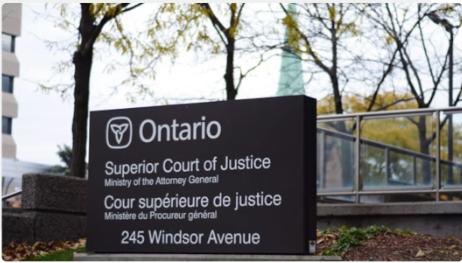
Stage two: the injunction. The Canadian Civil Liberties Association and the Criminal Lawyers’ Association applied to the Superior Court to have the deposit provisions declared unconstitutional, and sought an interlocutory injunction pending the outcome. Their position, in summary, was that criminal procedure is a federal head of power, that the Criminal Code leaves a justice discretion whether to order a security deposit and directs a preference for a promise to pay over cash, and that the provincial scheme removes that discretion and engages the section 11(e) Charter right not to be denied reasonable bail without just cause. The province’s position was that the measures are administrative, do not affect the conditions of release, and that the challenge rested on speculation about their effect.
The application was argued on August 27, 2026 before Justice William Chalmers. In a seven-page ruling released Monday, August 31, he granted the injunction, finding that the applicants had established that irreparable harm may result if it were not granted, and that there was <q>a greater risk of harm if the injunction is not granted</q>. He noted that the legislation may result in persons who would otherwise have been released having their release denied or delayed because of difficulty securing an able and willing surety, and that he was satisfied there was no harm to the province in granting it.
The deposit provisions are suspended pending the determination of the constitutional challenge. Justice Chalmers has reserved on the merits.
What this means for file preparation
The two layers now point in different directions, and the practical consequences separate cleanly.
The reverse onus analysis is unchanged and is the priority. With the categories expanded and the weapons lookback extended to ten years, onus status is a check against the record and the charge screening form, not an assumption. It determines the shape of the hearing and whether the ladder principle is available at all.
Build the plan as a document. Where a reverse onus applies, the accused must establish on a balance of probabilities that release is justified and that the plan addresses the identified risks. Residence, supervision, employment or schooling, treatment enrolment where relevant, curfew, geographic restrictions, and a transportation plan for court attendance and any conditions-related appointments, with supporting letters where they can be obtained.
Vet the surety against the federal bar, which still applies. An indictable conviction within ten years generally disqualifies. If the proposed surety is caught by that and no alternative exists, the interests-of-justice exception has to be argued with reasons going on the record: a different preparation task from simply proposing a surety.
Treat the deposit requirement as suspended, not repealed. An interlocutory injunction pending a merits determination is a temporary state. Plans prepared on the assumption that no deposit will be required should be capable of accommodating one if the provisions are restored, and files opened during the suspension period may need review depending on the outcome and any transitional provisions.
Anticipate the specified conditions. For offences where the court must consider particular conditions, addressing them in the proposed plan rather than responding from the bench is the stronger position.
Know the review routes. A bail review under section 520 of the Criminal Code allows the Superior Court to review a detention order.
A note on matter management
Two points follow for how a file is set up rather than how it is argued.
First, onus status is worth recording explicitly at intake, alongside the charge. With a ten-year lookback it is not reliably inferable from the charge alone, and it drives the volume of documentary preparation required.
Second, the amendment cadence is high and the state of the law is currently unsettled. Two levels of government amended bail practice within a month, one set of provisions was suspended within two weeks of coming into force, a merits decision is pending, and further Youth Criminal Justice Act provisions are to be proclaimed by order in council. Intake checklists and bail preparation templates need a scheduled review point, and any template amended for the deposit requirement in mid-August needs revisiting now.
This post describes a position that changed on August 31, 2026 and may change again. Confirm the current status of the deposit provisions and the constitutional challenge before relying on any of it.