


What is Practice Management System
A practice management system is not a bundle of modules. It is one data model with several views of it.
The modules : calendar, matters, contacts, email, time, conflicts, AI; they are not peers. They are windows onto the same underlying records. Calendar is a view of dated events on matters. Conflicts is a search across contacts. Timekeeping is entries attached to matters. Email filing is a question about which contact and which matter a message belongs to.
That distinction is invisible on a feature grid and determines nearly everything about how the software behaves after the first quarter. When the modules genuinely share records, a fact entered once reaches everything that depends on it. When they are separate products sharing a login, each one asks for the facts the others already hold, and a person supplies them again.
The single most diagnostic question a firm can ask during an evaluation:
How many times does one fact get entered?
Take a trial date. Count the places a person types it: the matter record, the calendar, the deadline tracker, the reminder, the file note, the spreadsheet beside the system. In a properly modelled system the answer is once. In most firms, measured honestly, it is three to five and each of those copies can drift from the others without anyone noticing.
We asked a version of that question across calls with twenty law firms. On duplicate entry of deadlines and court dates alone, the answers landed between roughly six and ten hours a month ten at the busy-docket end, around six at the lower end. Those conversations draw partly on firms we have worked with over a decade in legal software, not only on our own customers, and twenty is a small sample. The figure is a finding, not an industry statistic.
What it should be
Three things separate systems that hold up from systems that merely store information.
1. It should hold relationships, not copies
One relationship carries the weight of the entire system, and it is the one least examined during an evaluation: client, contact, matter.
A contact is a person or organization the firm knows: a client, an opposing party, a surety, an executor, an expert, a beneficiary, a referral source. A matter is a piece of work. A client is a contact in a particular role on a particular matter.
The same person can be a client on one file, a contact on another, and a witness on a third. A single matter can involve a dozens of contacts in different roles. Neither is unusual, and both are difficult to model if parties are stored as text fields on a matter rather than as records in their own right.
Get it wrong and the consequences are structural:
- A conflict search can only find what the system holds as a distinct, related party. Opposing parties typed into a free-text field are not searchable in any reliable sense.
- Email cannot file itself to a matter if the system does not know which contacts belong to it.
- A client’s history across files does not exist, because there is no single record of that person.
Firms usually discover this two years in, at the point where it is most expensive to change.
2. It should compute derived obligations, not store them
Most legal deadlines are not independent dates. They are derived; a rule plus an anchor. “Fifteen days before trial commencement” is not a date; it is an instruction that produces one when an anchor exists, and a different one when the anchor moves.
Nearly every system stores the output and discards the rule. The result is a calendar entry that was correct once. When the trial date moves, the entry does not, because nothing in the system ever knew the two were related.
A system built properly stores the rule against the anchor. When the anchor changes, everything computed from it recalculates. That is not a convenience feature. It is the difference between a calendar and a deadline system, and it is the single largest gap in the category.
3. It should model the practice area, not a generic container
A criminal matter and an estates matter behave differently. A criminal file is driven by court appearances, most of which are scheduling events and some of which establish milestones that obligations compute from. An estates file usually never reaches court at all and is anchored on dates entered manually like date of death, certificate issued.
A single generic matter container with custom fields bolted on can be made to hold both. It cannot make either behave correctly, because the behaviour is in the structure, not the fields.
Where Pluton fits
Built differently:
Deadlines are rules against anchors. This is the part we spent the most time on and the reason the product exists in the shape it does.
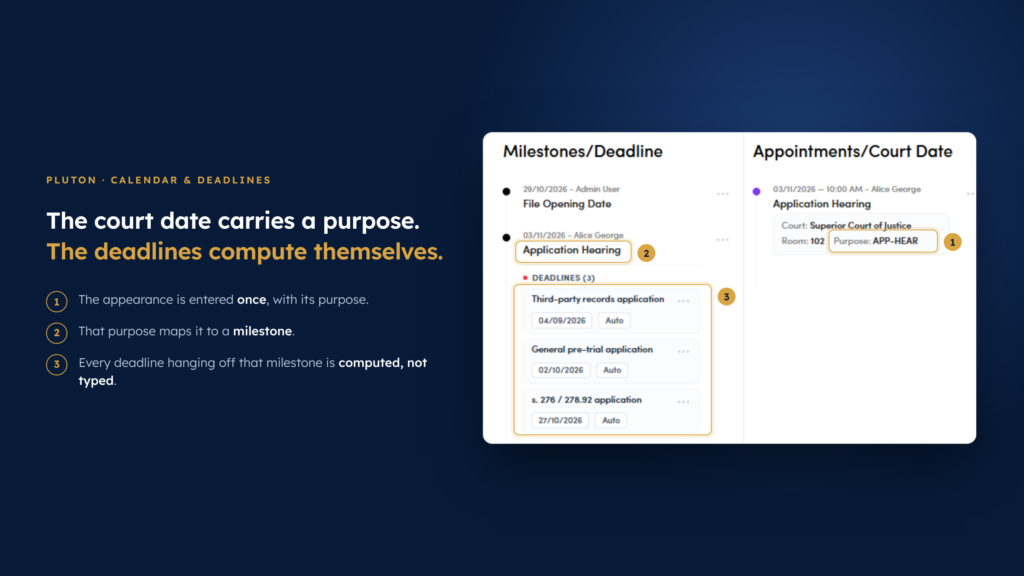
Three entities are kept separate because they behave differently. A milestone is an event worth tracking and the thing deadlines compute from. A deadline derives from a milestone by an offset. A court date is an appearance that may or may not establish a milestone. Court date carries a purpose, and only some purposes map to milestones. A routine set date triggers nothing; a trial commencement does.
When a court date’s date changes, the system raises a milestone conflict and asks whether to keep the existing anchor or update it. On update, the deadlines computed from that milestone recalculate. The milestone retains the full history of its court dates and exposes an anchor date that deadlines compute from: a manual override wins if one is set, otherwise the earliest date in the history. So an adjournment is a recorded event with a before and an after, not a field someone overwrote.
It is built for Canada. Ontario rules, Ontario courts, Canadian jurisdictions and holidays. Not a US product with a Canadian setting.
Criminal defence was modelled first and in the most depth, because it has the hardest scheduling behavior in the practice of law; anchors that move repeatedly, obligations that compound off a single date, and a delay clock running underneath. A system that handles criminal scheduling correctly handles the simpler cases without strain. The underlying structure works across practice areas.
Everything reads from one set of records. Contacts, matters and their relationships are the spine. Client intake, matter management, calendar, documents, time, billing and conflict search operate on the same records rather than keeping their own copies.